Discussing industrial innovation inevitably leads us to injection molding polymers—the foundational elements for creating high-durability components. From initial mold design to the final surface finish, polymer behavior dictates the structural integrity and quality of every single part.
At Atienza & Climent, as premier custom plastic injection molding manufacturers, we have mastered this lifecycle. Since 1997, we have been transforming complex engineering concepts into tangible, high-performance parts through rigorous production control. In this technical overview, we analyze the essential materials driving modern manufacturing.
Introduction to the World of Industrial Polymers
Injection molding polymers represent a turning point in the manufacturing of high-resistance components. Their exceptional versatility enables the production of complex industrial parts that are transforming entire sectors through their superior structural adaptability and mechanical performance.
What are Polymers? A Technical Definition
Understanding the nature of polymers is essential to recognizing their pivotal role in modern engineering. Polymers are macromolecules composed of repeating structural units known as monomers, which are chemically bonded to create materials with diverse physical properties.
These molecular bonds determine the material’s rheology, thermal stability, and its ability to adapt to high-precision manufacturing processes such as thermoplastic injection.
Types of Polymers: Natural vs. Synthetic
Polymer classification falls into two primary families, each exhibiting distinct behaviors and specialized applications within the production environment. The selection process is increasingly driven by sustainability metrics and lifecycle assessments.
Natural Polymers: Derived from organic sources—such as natural rubber (latex) or cellulose—these materials are prioritized for their biodegradability, biocompatibility, and inherent elasticity.
Synthetic Polymers: Engineered through controlled chemical synthesis, these polymers offer superior thermal stability, high tensile strength, and structural uniformity. They are the backbone of high-volume industrial production.
In modern manufacturing, both groups coexist to strike a balance between eco-friendly sourcing and technical performance.
Most Common Industrial Injection Molding Polymers
In the industrial manufacturing landscape, plastic polymers are distinguished by their chemical stability, superior moldability, and long-term durability. They are the preferred choice for engineers and manufacturers aiming for high-precision components. Below are the industry-leading materials:
Polyethylene (PE): Renowned for its lightweight nature and exceptional flexibility, PE offers high chemical resistance, making it ideal for containers and low-friction parts.
Polypropylene (PP): Widely utilized for structural components due to its optimal balance between stiffness and melt flow rate (MFR). It is a cost-effective solution for living hinges and automotive parts.
Acrylonitrile Butadiene Styrene (ABS): Engineered for high impact resistance, tensile strength, and excellent dimensional stability. ABS is the standard for high-precision technical parts and housings.
Understanding the distinct performance metrics of each resin is a critical step in production planning and mold engineering.
Injection Molding Polymers: Definition and Industrial Applications
In the field of advanced manufacturing, injection molding polymers serve as the foundation for the mass production of plastic components. Their ability to conform to complex mold geometries allows for the fabrication of parts with tight tolerances and exceptional surface finishes.
What is Plastic Injection Molding?
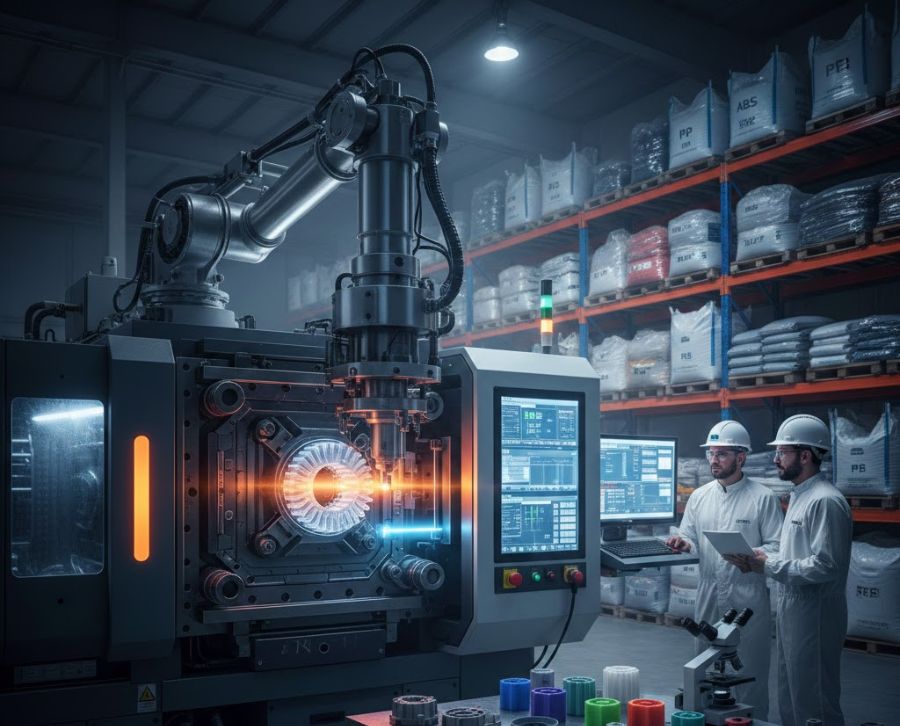
Plastic injection molding is a manufacturing process that involves melting polymer resins and injecting them under high pressure into a precision-engineered closed mold. Once cooled, the material solidifies, taking the exact shape of the cavity, ensuring high repeatability and dimensional accuracy.
This operation is one of the most versatile in the industrial sector, compatible with a vast range of thermoplastic polymers. Consequently, it is used to produce high-strength technical parts for demanding industries that require production efficiency and structural uniformity.
Which Polymers Can Be Injected?
The spectrum of polymers for injection ranges from general-purpose thermoplastics to high-performance engineering resins. Key materials include:
ABS and Polycarbonate (PC): For impact resistance and transparency.
Polyethylene (PE) and Polypropylene (PP): For chemical resistance and flexibility.
Nylon (Polyamide): For high-wear technical applications.
The selection of the specific resin depends strictly on the mechanical requirements and the intended environment of the final component.
Advantages of Injection Molding with Engineering Polymers
Utilizing engineering polymers in plastic injection molding ensures consistent, high-precision results tailored to complex industrial designs. The high level of process automation significantly reduces material waste and minimizes production lead times.
Key benefits include the seamless integration of metal inserts, specialized colorants, and technical additives that enhance the mechanical properties of the parts. Consequently, the injection process merges aesthetics, functionality, and structural resistance into a single, efficient operation.
Selection Matrix for Technical Injection Polymers
Selecting the correct injection molding resin is a strategic decision for any project. Each polymer offers a unique combination of hardness, density, and thermal behavior. Below, we break down the primary parameters for professional material selection.
Key Factors in Polymer Selection
Before finalizing a material, engineers must evaluate critical factors such as flexural modulus (rigidity), continuous service temperature, mold shrinkage, and melt flow index. Compatibility with pigments and specialized additives is also vital for the final application.
Furthermore, mold machinability and tooling requirements are decisive factors; certain macromolecules require higher injection pressures or specific thermal cycling, directly impacting the final part quality.
Technical Comparison: PP, ABS, PC, and PEI
Each material responds differently to manufacturing demands. Understanding these specificities allows for more precise and sustainable decision-making during the product design phase:
PP (Polypropylene): Extremely lightweight, cost-effective, and exhibits excellent chemical resistance.
ABS: Provides superior dimensional stability and a high-gloss surface finish.
PC (Polycarbonate): Distinguished by its optical transparency and high impact strength.
PEI (Polyetherimide): Offers extreme thermal rigidity and high-end mechanical resistance for aerospace and medical grades.
Property Table: Strength, Temperature, Flow Rate, and Cost
A comparative analysis of technical plastics includes variables that dictate their behavior during the injection cycle. Evaluating these metrics collectively ensures a more accurate production roadmap.
|
Aplicaciones típicas según el polímero seleccionado
Cada macromolécula se adapta a contextos específicos de fabricación. Analizar su desempeño en diferentes escenarios es esencial para definir estrategias productivas sostenibles. Estas son sus aplicaciones:
- ABS. Ideal para componentes estructurales y carcasas técnicas.
- PP. Común en envases, tapas y elementos de fijación.
- PC. Perfecto para piezas transparentes o de alta resistencia.
Entender el contexto de uso facilita elegir el material que combine rendimiento, estética y durabilidad.
Polímeros especiales: silicona, biopolímeros y compuestos avanzados
La innovación no se detiene, y el avance hacia compuestos más sostenibles y especializados es una realidad. A continuación, vamos a analizar los nuevos horizontes en la inyección moderna.
El polímero silicona: propiedades y usos
El polímero silicona destaca por su elasticidad y estabilidad térmica. Su capacidad de soportar altas temperaturas y su tacto suave lo hacen ideal para aplicaciones médicas y de consumo.
En inyección, se emplea en moldes específicos que permiten reproducir geometrías complejas sin perder detalle. Esta versatilidad lo convierte en una alternativa avanzada frente a los termoplásticos tradicionales.
Polímeros biodegradables y sostenibilidad en la inyección
El auge de los bioplásticos responde a la necesidad de reducir el impacto ambiental. Fabricados a partir de almidón o ácido poliláctico, ofrecen una degradación más rápida y menor huella de carbono. Su desarrollo continúa en expansión, con mejoras constantes.
H2: Typical Applications Based on Polymer Selection
Each macromolecule is engineered for specific manufacturing contexts. Analyzing material performance across different industrial scenarios is essential for defining sustainable and efficient production strategies. Common applications include:
ABS (Acrylonitrile Butadiene Styrene): The gold standard for structural components, technical housings, and rigid enclosures.
PP (Polypropylene): Predominantly used in packaging solutions, closures, caps, and heavy-duty fastening elements.
PC (Polycarbonate): The ideal choice for optical-grade transparent parts or components requiring extreme impact resistance.
Understanding the specific end-use environment facilitates the selection of materials that perfectly balance mechanical performance, aesthetics, and long-term durability.
Specialized Polymers: Silicone, Biopolymers, and Advanced Composites
Industrial innovation is constant. The shift toward sustainable manufacturing and specialized compounds is now a reality. Below, we analyze the new frontiers in modern plastic injection.
Silicone Polymers: Properties and Industrial Uses
Silicone polymers are distinguished by their exceptional elasticity and thermal stability. Their ability to withstand extreme temperatures and their soft-touch finish make them ideal for medical-grade applications and high-end consumer goods.
In the injection process, silicone requires specialized tooling to reproduce complex geometries with high precision. This versatility positions it as a high-performance alternative to traditional thermoplastics.
Biodegradable Polymers and Sustainability in Injection Molding
The rise of bioplastics addresses the global need to reduce environmental impact. Derived from renewable sources like corn starch or Polylactic Acid (PLA), these polymers offer a significantly lower carbon footprint and faster degradation rates. Their development continues to expand, with constant improvements in mechanical properties.