Toy molds are much more than a technical production tool. In the toy industry, a toy is not just an object. It is a tool for learning, exploration and development. That is why behind every manufactured part there is a process focused not only on functionality, but also on strict safety standards, creative shapes and consistent repeatability without errors.
Designing and manufacturing molds for toys means understanding the risks, production pace and technical and regulatory requirements of the industry. Safety is always a priority, geometries constantly evolve and cost per unit must be optimized in every decision.
At Atienza y Climent, as a company specialized in mold design and manufacturing services, we know the specific demands of the toy sector very well. In this article, we explain everything you need to know if you are developing a part for this market.
Why does mold design determine the success of a toy?
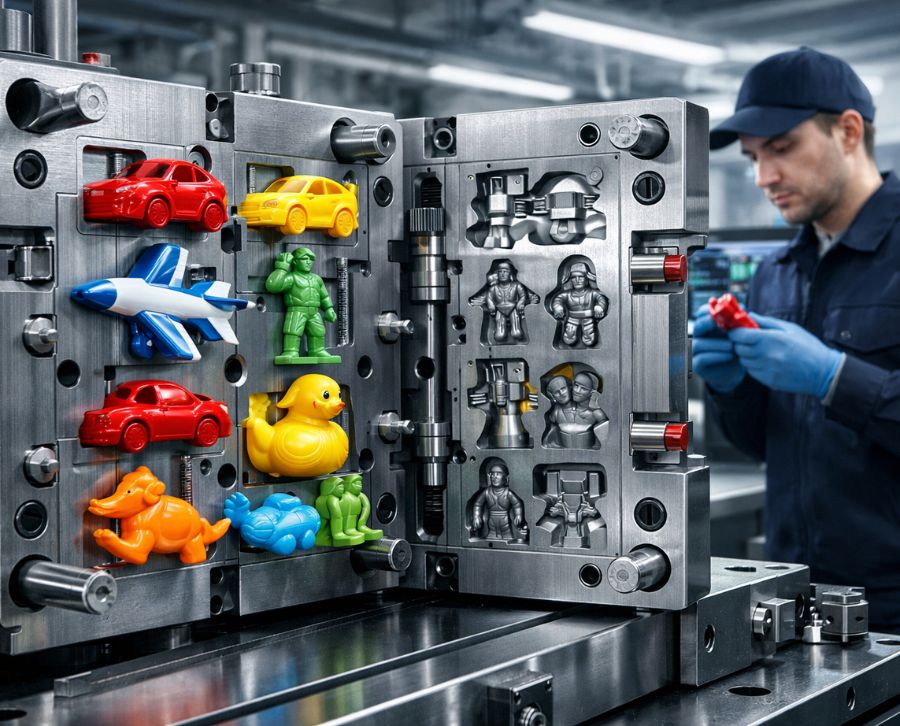
A toy is designed differently from a technical housing or a structural part. Its mold must adapt to colors, complex shapes, attractive textures and, in many cases, the combined use of different materials. That is why toy mold design requires a much more detailed development phase.
The difference between a standard mold and one intended for the toy industry lies in the details. It is not enough to replicate a shape. Every parting line, surface finish, decorative insert and ejection requirement must be carefully planned to avoid marks or defects.
In addition, an error at this stage can lead to mass rejections or, even worse, safety issues. This is why the quality of the mold design determines not only the appearance of the product, but also its functionality and profitability.
Safety from the steel itself: complying with EN71 toy safety standards
The EN71 toy safety standard is the technical framework that regulates what can and cannot be part of a toy sold in Europe. It is divided into several sections, among which the following are especially important:
Part 1: Mechanical and physical properties. It evaluates risks such as choking, cutting or trapping.
Part 2: Flammability. It controls how fire spreads through the materials used.
Part 3: Migration of certain chemical elements. It assesses the safety of materials that may come into contact with the mouth or skin.
This regulation affects product design, but it also has a direct impact on the mold itself. Poor parting line design can create sharp edges. Inadequate material selection may fail to meet chemical limits. An incorrect finish may affect how the product behaves during use.
Meeting this standard is not optional. For that reason, toy injection molds must be designed from the outset with these safety requirements in mind.
Types of molds used in the toy industry
In the toy industry, different types of molds are used depending on the product, material and production volume. The wide variety of toy formats, materials and manufacturing times requires specific solutions at each stage of a project.
When a toy manufacturer needs a fast solution to validate an idea, a prototype mold is usually the best option. When the goal is to produce millions of parts with maximum consistency, a high-production mold is preferred. If several different parts must be manufactured in a single cycle, a family mold becomes the most efficient solution.
Depending on the objective, the material and the type of toy, one approach or another will be more appropriate.
Prototype molds (aluminum or soft steel)
A prototype mold is used when the design is still under development. It is usually made from aluminum or soft steel and allows manufacturers to validate functionality and geometry without a major investment. These molds can also be used to simulate more complex production conditions, such as two-shot molding or overmolding, in order to predict how two different polymers will interact before moving on to the final mold.
High-production molds (hardened steel)
These molds are designed for long production runs. They are manufactured in hardened steel and can withstand high pressure while maintaining repeatability over millions of cycles. They are the preferred option for toy suppliers who need stable, reliable production with no deviation over time.
Although they require a higher initial investment, high-volume toy molds reduce the cost per part and minimize the need for intermediate adjustments.
Family molds
Family molds make it possible to produce several different parts in the same injection cycle. They are especially useful in modular toy lines or sets that include multiple small components. A toy manufacturer may choose this option when looking to optimize time and production space while balancing tooling costs and final functionality.
The challenge of creativity: complex geometries and multi-material injection
Creativity is an essential part of toy design. This often results in geometries with hollow areas, decorative textures, difficult demolding requirements or the need to combine different materials within the same part.
Molds for the toy industry must solve these challenges without compromising safety or increasing costs unnecessarily. The use of sliders, moving inserts or multi-injection areas allows manufacturers to meet requirements that would be difficult to imagine in many other sectors.
In addition, combining soft and rigid materials requires expertise in processes such as multi-material injection molding or two-shot injection molding, so that aesthetics and functionality can coexist in a single product.
Why manufacture your toy molds with Atienza y Climent?
At Atienza y Climent, we develop complete solutions for the toy sector. We not only understand the technical and regulatory requirements, but also have the experience and resources needed to solve any design or production challenge.
If you are looking for a toy mold manufacturer in Spain that understands safety regulations, industry lead times and the importance of precision, you will find a team with more than 30 years of experience turning ideas into functional, safe molds ready for production.
Preguntas frecuentes sobre la fabricación de juguetes
El precio depende del tipo de molde, del material, del número de cavidades y de la complejidad de la pieza. Un molde prototipo puede costar desde unos pocos miles de euros, mientras que un molde de alta producción requiere una inversión superior.
Un molde de acero templado puede durar millones de ciclos si se fabrica y mantiene correctamente. Es la mejor opción cuando se busca fiabilidad y producción a largo plazo.
Sí, siempre que los materiales reciclados cumplan la normativa EN71 de seguridad en juguetes. Es importante validar su composición química y su comportamiento mecánico antes de utilizarlos.
El plazo medio suele estar entre 4 y 8 semanas, dependiendo de la complejidad del diseño, el tipo de molde y si es necesario hacer pruebas previas o ajustes de ingeniería.