Designing industrial technical parts goes far beyond drawing shapes and defining dimensions. It means developing components that fit real production environments, withstand repeated cycles, meet tolerance requirements and deliver reliable structural and functional performance.
Technical part design is about understanding the final application, anticipating manufacturing constraints, optimising geometry and making every engineering decision with production in mind. It is not about creating forms at random, but about turning technical needs into efficient, manufacturable and durable solutions.
At Atienza y Climent, we have been doing exactly that for more than 30 years. Our team transforms ideas into real industrial components through a practical methodology focused on precision, functionality and production efficiency.
Why choose Atienza y Climent for technical industrial parts design
Our experience is built on real parts that have been designed, manufactured, tested and improved through years of collaboration with companies from multiple industrial sectors. We work from the initial concept to tooling and final production, using in-house resources, advanced technology and an end-to-end industrial vision.
Here are some of the reasons why companies choose us for industrial parts and tooling design:
- Proven experience: more than three decades designing functional components for real industrial projects, from short runs to continuous production.
- Advanced technology: 3D modelling, CAD/CAM software, process simulation, in-house machining and structural validation with updated tools.
- Full-service development: from conceptual design to mold manufacturing, plastic injection, finishing and final delivery.
- Tailored engineering: we adapt each design to the geometry, material, function and production conditions of the final part.
- Precision at every stage: dimensions, tolerances, wall thicknesses and fits are validated from the first draft to avoid redesigns later.
- In-house multidisciplinary team: designers, engineers, technicians and project specialists work together to reduce errors and accelerate development.
Our goal is to deliver functional, optimised and production-ready parts from the very first iteration.
Industries we work with
Injection-molded technical part design is relevant across many industries, but each one comes with its own technical, regulatory and manufacturing challenges. At Atienza y Climent, we develop specific solutions for every case, adapting geometries, materials and tolerances to real operating conditions.
Some of the sectors we regularly serve include:
- Toys and collectibles: complex geometries, long production cycles and compliance with standards such as EN71 for child safety.
- Promotional products and events: visually attractive parts, textured finishes and cost-efficient production for large volumes.
- Hospital and medical sector: functional components with tight tolerances, safe finishes and materials aligned with healthcare requirements.
- Technical packaging: lightweight, durable solutions designed for automated filling, handling and logistics processes.
- Consumer products: everyday-use parts requiring precise assembly, ergonomic design and long-term mechanical durability.
- Custom developments: exclusive components for specific campaigns, short production runs or differentiated product concepts.
We adapt each project to the industry, application and technical requirements of every client.
Our technical parts design process
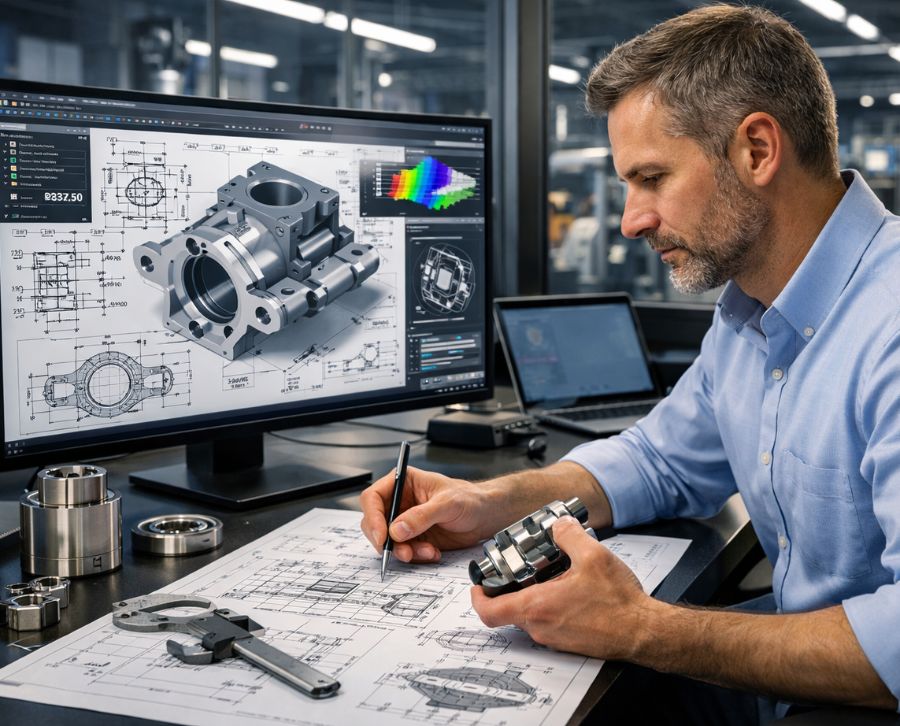
Industrial part design starts by understanding how the component must perform, which material will be used and what tolerances are required. Every technical decision must support stable, repeatable and cost-efficient production. That is why we follow a structured engineering process that ensures precision and manufacturing reliability.
Initial analysis and 3D modelling
At this stage, we study the part from a functional perspective. We analyse geometry, identify critical areas and create a 3D model designed for stable production, avoiding demolding issues and unnecessary post-production adjustments.
Prototyping and validation
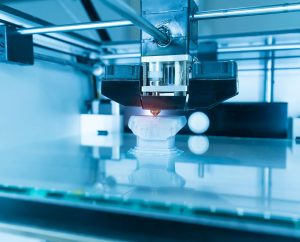
Depending on the type of component, we produce prototypes through 3D printing or machining. This makes it possible to validate shapes, fits and mechanical behaviour before manufacturing the final mold, while allowing adjustments in the design stage if needed.
Production optimisation
Once the prototype is approved, we refine wall thicknesses, parting lines and injection gate locations. This stage closes the product design cycle by adapting the component to the actual behaviour of the material and the manufacturing parameters required for serial production.
Benefits of our industrial technical parts solutions
Designing industrial components means making decisions that directly affect manufacturing, assembly and final product performance. A well-engineered part reduces downstream problems, improves efficiency and increases the profitability of the whole production process.
Key advantages of working with our team include:
- Fewer manufacturing errors: we anticipate shrinkage, deformation and critical areas before tooling begins.
- Shorter development times: designs are created with molding and production requirements already integrated.
- Less waste: we reduce rework, failed tests and unnecessary material consumption.
- Material-driven engineering: every design is adapted to the physical and mechanical properties of the final material.
- Better profitability: each technical decision is made to improve mold performance and shorten production cycles.
Our objective is simple: to create technical parts that are functional, efficient and stable from the first production run.
Common design mistakes and how to avoid them
One of the most common mistakes in technical part design is prioritising appearance over manufacturability. It is also frequent to design without considering mold limitations, injection system requirements or the correct wall thickness for the selected material. In many cases, insufficient attention is paid to demolding, functional tolerances or the way plastic behaves during cooling, which later creates production issues. This risk is highlighted by the article’s own focus on tolerances, geometry optimisation and production constraints.
At Atienza y Climent, we design industrial parts to prevent these problems from the start. By integrating design, prototyping, tooling and production thinking into one process, we help clients reduce risk and move faster from idea to manufacturing.
Frequently asked questions about industrial technical parts design
The cost depends on the complexity of the part, the material, the required tolerances, the development stages involved and whether prototyping or tooling design is included. A simple component may require a limited engineering effort, while a complex production-ready part requires more extensive design and validation work.
Material selection depends on the part’s function, mechanical requirements, temperature exposure, regulatory conditions and production method. Common options include technical plastics, engineering polymers and other materials chosen according to structural or functional performance.
Prototyping helps validate dimensions, fit, assembly, functionality and possible design improvements before investing in the final mold or tooling. It reduces risk, saves time and prevents costly modifications later.
Yes. Our process is focused on developing parts that are ready for manufacturing, including geometry optimisation, thickness control, demolding criteria, tolerance definition and adaptation to the selected production technology.