In an increasingly competitive industrial market, bringing a product to market too late can lead to unnecessary costs, delays, and missed opportunities. That is why industrial prototyping has become a key stage in product development: it allows companies to validate an idea before committing resources to production, reduce errors, and make decisions with greater confidence.
More than just a model, a prototype is a validation tool. It helps confirm whether a part meets requirements in terms of shape, fit, ergonomics, strength, or functionality before moving into mass production. In other words, it replaces assumptions with real-world testing.
At Atienza & Climent, we understand prototyping as a strategic part of technical development. That is why we integrate it with industrial design and advanced manufacturing processes to help companies shorten lead times, reduce risk, and move toward more reliable, competitive, and cost-effective solutions.
What is industrial prototyping?
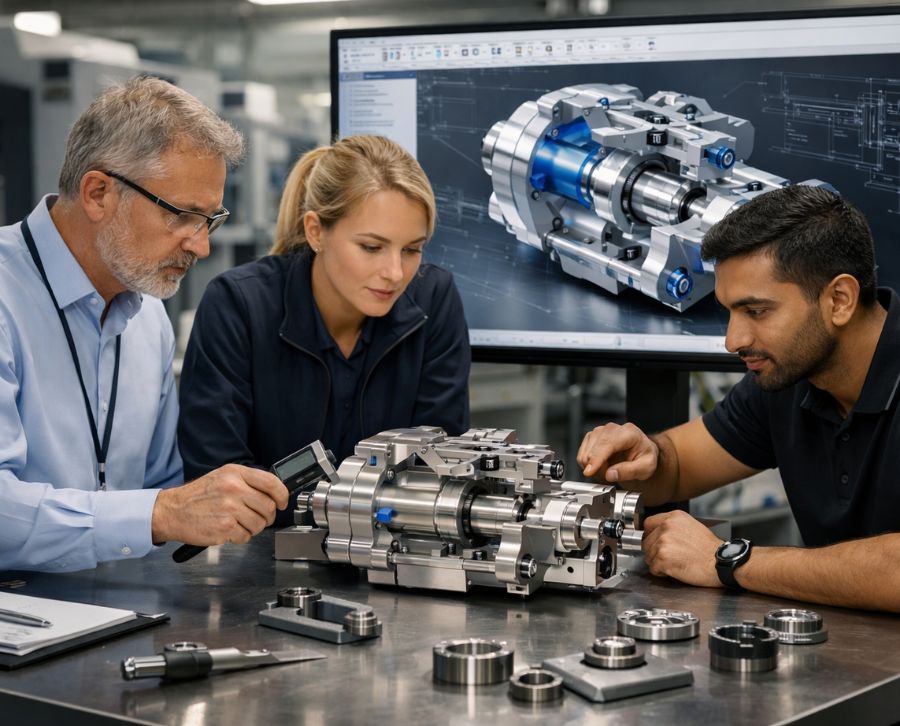
Industrial prototyping is the process of turning a CAD design into a physical part or assembly in order to validate its shape, fit, function, and feasibility before mass production begins. It is the stage where a technical concept becomes a real component that can be tested, reviewed, and improved.
Its value does not lie only in visualising the product, but in identifying design errors, assembly interferences, ergonomic issues, or functional limitations while they are still manageable in terms of time and cost.
For that reason, rapid prototyping should not be seen as an optional extra, but as a decision-making tool. The earlier a problem is detected, the easier and cheaper it is to solve without affecting the rest of the project.
What is industrial prototyping used for?
Industrial prototyping makes it possible to assess, in practical terms, whether a product will perform as expected before production starts. Its benefits extend across technical, aesthetic, functional, and economic aspects.
Its most common applications include:
- Validating fit and assembly, identifying incompatibilities between parts before investing in tooling or final moulds.
- Testing functional performance under real or simulated conditions.
- Assessing ergonomics, proportions, and finishes, especially in products with user interaction or strong visual requirements.
- Running early tests with clients, users, or internal teams, allowing improvements before manufacturing.
- Reducing technical uncertainty, making decisions faster and with less risk.
In many industrial projects, the greatest value of a prototype is not only confirming that an idea works, but revealing what needs to change before production can be efficient, repeatable, and profitable.
Types of industrial prototypes
Not all prototypes serve the same purpose. Choosing the right type depends on what needs to be validated at each stage of development.
Visual prototypes
These are used to review dimensions, geometry, overall volume, and the product’s visual appearance. They are especially useful in early stages, when the design is still being defined.
Ergonomic prototypes
These help assess grip, usability, accessibility, and user interaction with the part. They are particularly important in products that need to be handled, assembled, or used frequently.
Functional prototypes
These are intended to validate strength, fit, assembly, and mechanical performance. They are used when the objective is to determine whether the part behaves correctly in real use.
Pre-series prototypes
These are produced with a level of fidelity very close to the final product, both in terms of materials and process. They are useful for validating the stage immediately before industrialisation or pilot production.
Stages of the industrial prototyping process
Prototyping combines modelling, technical judgement, material selection, and practical validation. Although every project has its own specific requirements, the process is usually structured in several clearly defined stages.
CAD design and 3D modelling
Everything starts with the digital development of the part or assembly. The CAD model defines dimensions, wall thicknesses, tolerances, assemblies, and relationships between components.
This phase is essential because it helps detect inconsistencies before anything is manufactured. It also makes it easier to visualise the product and creates the basis for choosing the most suitable prototyping technology.
Defining the validation objective
Before manufacturing begins, it is essential to answer a key question: what exactly should the prototype validate?
Validating an aesthetic finish is not the same as checking mechanical strength, assembly, or user experience. Defining this objective prevents unnecessary parts from being made and helps guide the process more effectively.
Selecting materials and technology
Once the objective has been defined, the most suitable materials and manufacturing technology are selected. This decision depends on factors such as the level of detail required, the expected performance of the part, the budget, the timeframe, and the type of validation needed.
At this stage, a poor choice can lead to misleading conclusions. For example, a visual prototype may not be suitable for validating strength, just as a functional part may not accurately reproduce the surface finish of the final product.
Manufacturing the prototype
With the design and technology defined, the part can be produced. Depending on the chosen process, this may involve 3D printing, CNC machining, or even an injection-based solution when validation with final materials is required.
Testing, review, and improvement
Once manufactured, the prototype is evaluated. At this point, the following aspects are typically reviewed:
- fit between components
- assembly
- critical tolerances
- strength
- ergonomics
- behaviour in use
- visual appearance and finish quality
This phase makes it possible to introduce changes before moving to a more advanced stage of the project. In industrial development, iterating early is usually far more cost-effective than correcting issues later.
Technologies used in industrial prototyping
Today, several technologies can be used to produce prototypes with different levels of fidelity, precision, and cost. The right choice depends on how the part will be used.
Industrial 3D printing
3D printing is one of the most widely used technologies in rapid prototyping because of its speed and versatility. It allows parts to be produced layer by layer from a digital file, reducing lead times and enabling quick design iterations.
SLA
SLA technology is particularly suitable when a high level of surface detail and strong visual quality are required. It is often used to validate complex geometries, presentations, or formal design aspects.
SLS
Selective laser sintering makes it possible to manufacture stronger parts with good mechanical performance and no need for support structures. It is a very useful option when the goal is to run functional or assembly tests.
FDM
FDM is a practical solution for early validation, dimensional checks, and fast prototypes with a controlled budget. It can be especially useful in early project stages where speed is a priority.
CNC machining
CNC machining is the best option when the prototype needs to reflect the behaviour of the final part more closely in terms of material, tolerances, or surface finish. Starting from a solid block, the exact geometry of the component is machined with high precision.
It is particularly recommended for technical parts, functional components, housings, tooling, or any application where fit accuracy and material strength are critical.
Injection moulding for advanced validation
When a project requires testing the product using materials close or identical to the final ones, injection moulding can be an interesting option in advanced stages or pre-series validation.
It allows textures, strength, assembly behaviour, and repeatability to be assessed, especially when the next step is close to industrialisation.
How to choose the right prototyping technology
There is no single solution that fits every project. The right technology depends on the validation goal.
As a general guide:
- If you need to validate aesthetics and detail, SLA is often a good choice.
- If you need to test assembly or functional behaviour, SLS may deliver better results.
- If you need to reproduce material, precision, and finishes closer to production, CNC machining is usually the best option.
- If you need to validate the product with final materials or at a stage close to production, pre-series or injection-based solutions should be considered.
Making the right choice at this stage improves not only the quality of the prototype, but also the quality of the decisions made afterwards.
Benefits of industrial prototyping for companies
Integrating prototyping into product development brings clear technical, operational, and economic advantages.
It reduces development time
Validating before manufacturing makes it possible to identify issues early and speed up decision-making. Each well-planned iteration helps avoid major delays later in the process.
It reduces costs and rework
Identifying a fit, geometry, or functionality issue before producing moulds or launching manufacturing prevents unnecessary investment, repeated work, and material waste.
It improves final product quality
Prototypes make it possible to check whether the design truly meets expectations in terms of use, assembly, strength, and finish. This helps companies enter production with greater control.
It improves communication between departments
Having a physical part improves understanding between design, engineering, production, and the client. Discussions are based on a real object, not on interpretation alone.
It supports better decision-making
Prototyping reduces uncertainty. It helps teams decide more confidently when to iterate, when to approve, and when to move into pre-series or final production.
Differences between prototyping and mass production
Although both belong to the same development cycle, industrial prototyping and mass production serve very different purposes.
Prototyping is meant to validate, learn, and improve. Mass production is meant to reproduce consistently, efficiently, and at scale.
The main differences are:
- Volume: prototyping usually involves one-offs or very short runs, while production is designed for large quantities.
- Objective: a prototype is used to validate; mass production is used to manufacture consistently.
- Flexibility: prototyping allows quick modifications; in serial production, changes are more expensive and disruptive.
- Materials and processes: prototyping prioritises validation; mass production prioritises efficiency and repeatability.
- Lead times: prototyping is designed for rapid iterations; production follows industrial planning.
Understanding this difference is essential: a good prototype does not replace production, but it significantly improves the way a company gets there.
When is it worth investing in industrial prototyping?
Prototyping is especially recommended when:
- the product includes complex geometries
- several parts need to be assembled together
- there is functional or mechanical risk
- ergonomics or user interaction must be validated
- the project needs to reduce uncertainty before manufacturing
- the transition from design to production needs to be accelerated
In these cases, having a physical part makes it possible to identify issues that may not always be visible on screen and move forward on a much stronger basis.
Why choose Atienza & Climent for industrial prototyping?
At Atienza & Climent, we see industrial prototyping as a key tool for developing products with greater precision and less uncertainty. It is not simply about producing a sample, but about helping every technical decision be based on something real and measurable.
We support our clients throughout the entire process, from concept definition and CAD modelling to technology selection, prototype manufacturing, and functional validation. Thanks to our experience in industrial processes, machining, and technical development, we are able to adapt each solution to the real objective of the project.
The result is a process that is faster, more controlled, and better prepared for reliable production.
Preguntas frecuentes sobre el prototipado industrial
Depende de la complejidad de la pieza, la tecnología elegida, los materiales y el nivel de validación requerido. En general, el prototipado permite plazos mucho más cortos que la fabricación industrial definitiva.
Cuando se busca validar montaje, resistencia o uso real, suelen valorarse tecnologías como SLS o mecanizado CNC. La mejor opción depende del comportamiento que se quiera reproducir.
El CNC es recomendable cuando la pieza debe acercarse al material final, ofrecer alta precisión o reproducir tolerancias críticas. La impresión 3D destaca cuando prima la rapidez, la iteración o la libertad geométrica.
Se emplean resinas técnicas, poliamidas, termoplásticos y metales, entre otros. La elección depende del objetivo del prototipo: visual, funcional, ergonómico o de pre-serie.
Cuando el diseño ya ha sido validado y el siguiente paso requiere comprobar comportamiento, repetibilidad o adaptación a un proceso productivo más cercano al definitivo.