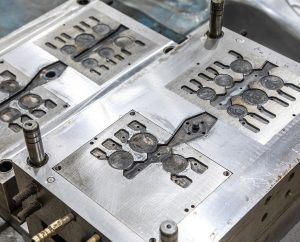
Mold manufacturing requires precision, planning, and full control at every stage. When the process goes wrong, costs rise, lead times increase, and the quality of the final product suffers.
Mastering this stage makes it possible to produce efficiently, reduce waste, and respond quickly to market demands. At Atienza & Climent, as experts in product development and mold manufacturing, we explain how molds are made to achieve precise, high-quality parts.
What Mold Manufacturing Is and Why It Matters in Industry
In simple terms, mold manufacturing consists of creating a functional tool designed to serve multiple purposes. Manufacturers use molds in sectors such as automotive, toys, and medical devices. This process helps ensure products perform better and are more successful in the market.
Many companies work in this field, but Atienza & Climent takes a distinctive approach. We handle both small and large production runs, which allows us to adapt to a wide range of project requirements.
Main Stages of Mold Manufacturing
Plastic mold manufacturing requires meticulous planning and highly specialized execution. These are the main stages of this custom production process:
- Design
- Machining
- Assembly
- Testing
- Finishing
Each stage has specific objectives that ensure maximum efficiency and performance of the finished components. To make things easier, we explain each phase below so you can better understand its purpose and scope.
Stage 1: Mold Design
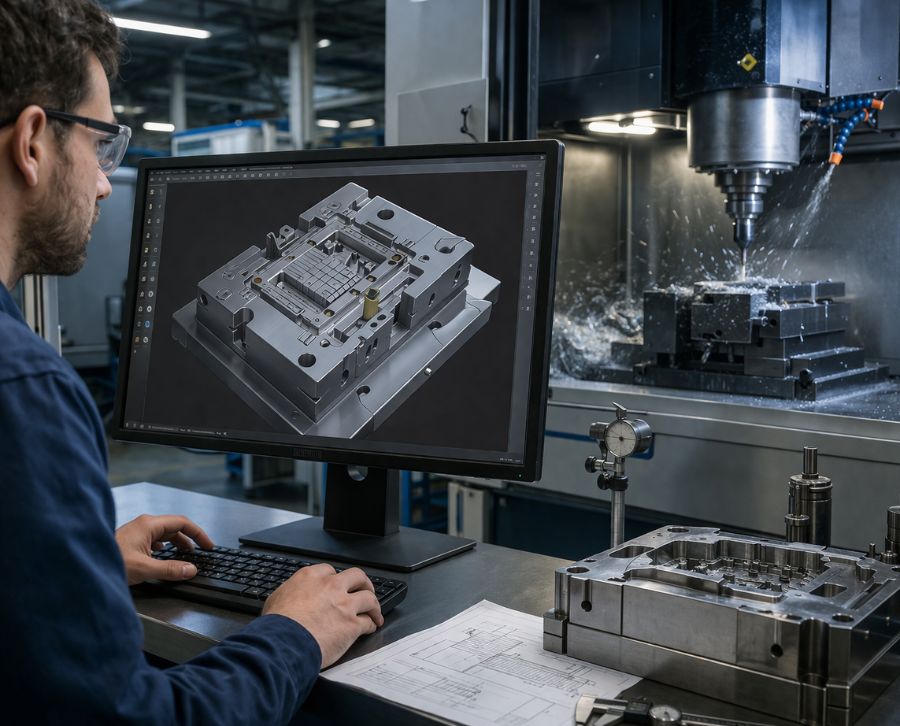
The design stage defines the geometry, functionality, and performance of the mold. This is a critical phase, as engineering teams create models using CAD design software. These tools make it possible to analyze shrinkage, supports, parting lines, and material flow channels, helping to prevent defects in the final result.
In more advanced projects, a CAM workflow may also be integrated to generate automatic programs for CNC manufacturing. At this stage, factors such as part complexity, tolerances, expected production volume, and cooling systems are also considered, since they directly affect the final quality.
Stage 2: Material Selection
At this stage of mold manufacturing, materials are selected based on the hardness, durability, and thermal stability required for production. There are many options available, such as hardened steel, aluminum, and technical alloys. Each material has a different service life and a different level of complexity when it comes to modifications or adjustments.
For rapid prototyping, 3D printing can also be used to meet the demands of more exacting customers. This technology is especially useful for testing and refining designs before moving into mass production. It also allows for more efficient customization.
Stage 3: Machining and Manufacturing
This is one of the most important stages, as CNC machining centers, EDM, and other specialized manufacturing processes are used to create precise cavities. During this phase, dimensional inspections are carried out to verify measurements and tolerances, which helps improve the quality of the final product.
Producing parts requires high-precision cutting tools and a deep understanding of the material being worked on. This helps prevent deformation and ensures thermal stability during production. It can also be adapted to different types of materials, including plastics and metals.
It is also possible to carry out injection mold manufacturing for plastic parts in order to achieve a distinctive and high-quality result. Everything depends on the intended use of the product, so one manufacturing technique may be better suited than another for a given industrial process.
Stage 4: Mold Assembly and Adjustment
The different parts are assembled, adjusted, and checked to ensure a perfect fit and proper closing. At the same time, the ejection, cooling, and movement systems are reviewed. It is worth remembering that working with industrial molds requires extremely precise adjustments to guarantee stability and performance.
Stage 5: Testing, Validation, and Continuous Improvement
The testing phase verifies part quality according to strict evaluation criteria. Material is injected into the mold to assess tolerances, surface finishes, and dimensional stability. Based on these results, any imperfections are corrected to achieve consistent performance in large production runs.
Stage 6: Mold Finishing and Maintenance
This stage focuses on the finishing of the internal surface and the overall protection of the mold. This may include texturing, polishing, chrome plating, or heat treatments that improve durability. To prevent wear and extend service life, regular maintenance is essential, as it helps keep the machining and production process running smoothly.
Since this is the final stage, the evaluation criteria are stricter. In some cases, defective molds are rejected altogether, but this is done to ensure the highest possible quality of the finished parts.
Advantages of a Controlled Manufacturing Process
A controlled process ensures dimensional accuracy, durability, and cost reduction. By working with expert suppliers, companies obtain a stable tool capable of maintaining quality throughout the production cycle. One of the main benefits is that fewer adjustments are needed and the service life of the parts is extended.
It is also important to remember that good process control reduces errors, making it easier to manufacture complex tools while helping identify defects early on. Efficiency improves, which enhances the company’s overall performance. In addition, this level of control strengthens reputation and helps the business stand out from competitors.
Why Choose Atienza & Climent for Mold Manufacturing
At Atienza & Climent, we offer experience, technical capability, and a comprehensive approach to the development of custom molds. We work with demanding industrial sectors where precision and quality determine the success of every project. For this reason, our company supports clients throughout the entire process.